
Government Prepares 9 Economic Incentives for 2027, from Expanded PPh Article 21 DTP to a Potential PTKP Increase
October 28, 2026
Transactions Using QRIS Are Subject to Tax; Here Is the Explanation from the DGT
November 6, 2026
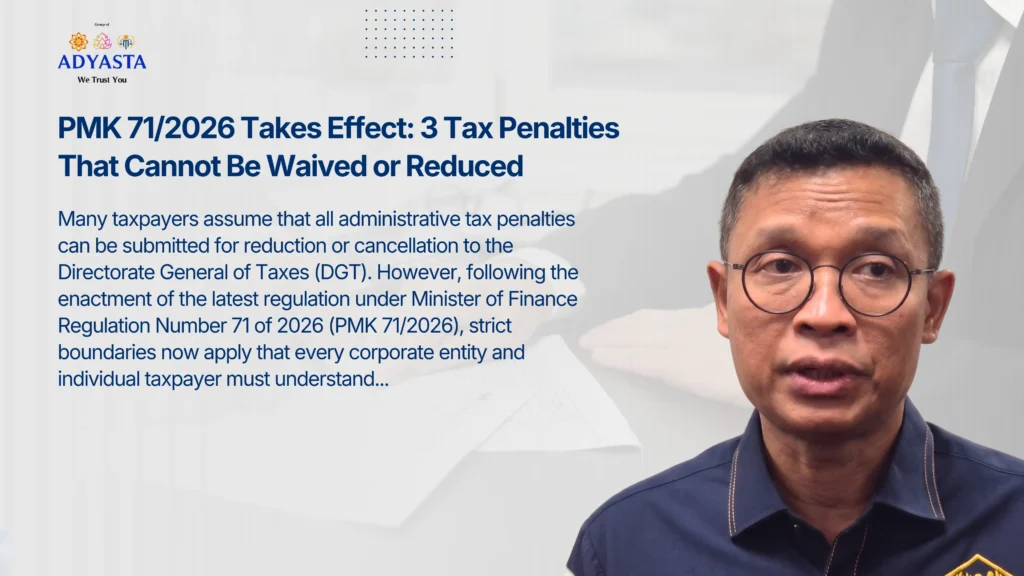
Many taxpayers assume that all administrative tax penalties can be submitted for reduction or cancellation to the Directorate General of Taxes (DGT). However, following the enactment of the latest regulation under Minister of Finance Regulation Number 71 of 2026 (PMK 71/2026), strict boundaries now apply that every corporate entity and individual taxpayer must understand.
Through this regulation—which amends PMK 118/2024—the government specifically excludes several categories of administrative sanctions from reduction or cancellation facilities. Conversely, general administrative penalties such as late filing of Tax Returns (SPT) or late tax payments remain eligible for relief. This article breaks down the list of non-reducible sanctions alongside the provisions for penalties that can still be waived.
Regulatory Updates Under PMK 71/2026
The Directorate General of Taxes (DGT) has officially updated the guidelines governing the reduction and cancellation of administrative tax sanctions by issuing PMK 71/2026 as an amendment to PMK 118/2024.
A crucial point in this update is stipulated under Article 21A letter b of PMK 118/2024 as amended by PMK 71/2026, which emphasizes that not all tax penalties are eligible for reduction or cancellation requests. This restriction specifically targets administrative sanctions arising from tax legal remedies, whereas sanctions resulting from taxpayer oversight (kekhilafan) or through no fault of their own remain eligible for reduction or cancellation provided the applicable requirements are met.
3 Types of Administrative Tax Sanctions Eligible for Neither Reduction Nor Waiver
Under the provisions of Article 21A letter b of PMK 118/2024 as amended by PMK 71/2026, 3 (three) categories of administrative sanctions cannot be submitted for reduction or cancellation through the mechanism of Article 36 paragraph (1) letter a of the Law on General Provisions and Tax Procedures (UU KUP):
1. Penalties Resulting from Rejected or Partially Approved Tax Objections If a taxpayer files a tax objection and the DGT decides to reject or only partially approve the submission, the taxpayer may be subject to an administrative sanction in the form of a 30% penalty. Penalties arising from an objection decision are binding and cannot be submitted for reduction or cancellation.
2. Penalties Resulting from Rejected or Partially Approved Tax Appeals When a dispute proceeds to the Tax Court and the appeal ruling states that the taxpayer’s petition is rejected or only partially granted, the taxpayer may be subject to a 60% penalty. Similar to the objection stage, this appeal penalty is excluded from sanction reduction or waiver facilities.
3. Penalties Resulting from a Judicial Review (PK) That Increases Tax Payable If a Judicial Review (PK) ruling increases the amount of tax that must be paid, the taxpayer may be subject to a 60% penalty. Administrative sanctions arising from a PK ruling are likewise excluded from the DGT’s sanction reduction or cancellation mechanisms.
Strategic Steps in Navigating Tax Sanctions and Disputes
The enactment of PMK 71/2026 serves as a vital reminder for taxpayers that sanctions resulting from legal remedies such as objections, appeals, and judicial reviews carry financial consequences that cannot be waived under Article 36 paragraph (1) letter a of the UU KUP. Nevertheless, for taxpayers facing administrative penalties—such as late SPT filing or late tax payment—due to oversight or through no fault of their own, applying for sanction reduction or cancellation to the DGT remains open as long as the applicable requirements are fulfilled.
If you or your company are facing challenges with tax compliance, seeking to apply for administrative sanction relief, or requiring legal representation in tax disputes, ADYASTA Consulting is ready to assist you. Backed by over 15 years of experience and a dedicated team of Certified Tax Consultants and professional Lawyers, we are committed to delivering accurate legal and tax solutions tailored to your business.