
KEP-239/PJ/2026: Tax Invoice Penalties Can Be Reduced by Up to 90%
October 27, 2026
PMK 71/2026 Takes Effect: 3 Tax Penalties That Cannot Be Waived or Reduced
November 3, 2026
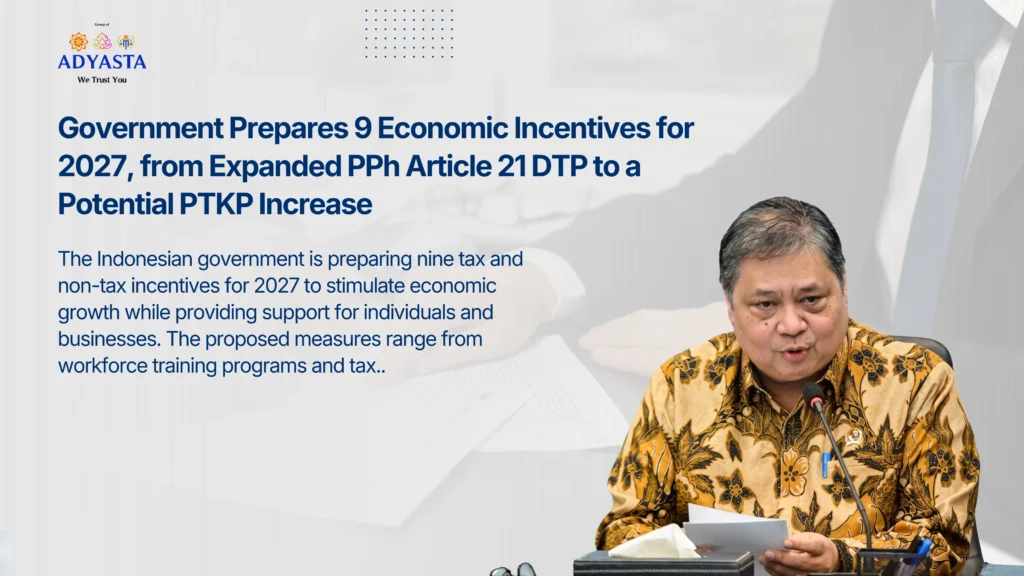
The Indonesian government is preparing nine tax and non-tax incentives for 2027 to stimulate economic growth while providing support for individuals and businesses. The proposed measures range from workforce training programs and tax relief to housing assistance.
Coordinating Minister for Economic Affairs Airlangga Hartarto stated that several existing programs will be continued or expanded next year. Among the key proposals are an expansion of the Government-Borne Income Tax (PPh Article 21 DTP) facility and a potential increase in the Non-Taxable Income threshold (PTKP).
9 Economic Incentives Planned for 2027
The following are the nine incentives the government is preparing to support individuals and businesses in 2027.
1. National Internship Program
The government plans to continue the National Internship Program, targeting 150,000 participants. Benefits will include a stipend, protection against work-related accidents and death, a certificate of completion, and the Government-Borne Income Tax (PPh Article 21 DTP) facility.
2. National Vocational Training Program
The government is preparing a national vocational training program with a quota of 300,000 participants. The initiative aims to improve people’s skills and prepare them to enter the workforce in line with industry needs.
3. Expanded Government-Borne Income Tax (PPh Article 21 DTP)
The government plans to cover PPh Article 21 for employees earning up to IDR 10 million per month across all business sectors.
If implemented as proposed, eligible employees could receive higher take-home pay because their income tax would be borne by the government. The technical regulations for this incentive are expected to be issued before January 1, 2027.
4. Potential Increase in the Non-Taxable Income Threshold (PTKP)
The government also plans to increase the Non-Taxable Income threshold (PTKP), taking inflation and district or municipal minimum wages (UMK) into consideration.
If implemented, the increase would raise the income threshold exempt from Income Tax (PPh) for individual taxpayers. However, the new PTKP amounts have not yet been determined, and taxpayers will need to wait for official regulations.
5. Government-Borne VAT for Home Purchases
To support the property sector and help people purchase homes, the government is preparing a Government-Borne Value Added Tax (VAT DTP) incentive for home purchases with a sale price component of up to IDR 2 billion.
This incentive is expected to reduce home-buying costs. The technical regulations are planned to be finalized before January 1, 2027.
6. 50% Discount on Work Accident and Death Insurance Contributions
The government plans to provide a 50% discount on contributions to Work Accident Insurance (JKK) and Death Insurance (JKM) for Non-Wage Recipient (BPU) participants, including self-employed workers.
The policy is intended to reduce social security contribution costs for eligible participants. The relevant regulations are expected to be revised before January 2027.
7. Additional Benefits under Job Loss Insurance (JKP)
The government is also planning to introduce additional benefits under the Job Loss Insurance (JKP) program, which provides protection for workers who experience termination of employment.
Details regarding the additional benefits, eligibility requirements, and implementation mechanisms are still subject to further regulations.
8. Subsidized Housing Loans for the Middle-Income Vulnerable Group (MBT)
Subsidized housing loans are also included in the government’s proposed incentives. The program is intended to help the Masyarakat Berpenghasilan Tanggung (MBT) group gain easier access to home financing.
9. VAT Adjustments for Gold and Silver
The government plans to adjust the standards for VAT exemption on gold with a purity level of 99.9% and explore the possibility of providing VAT incentives for silver.
The measure aims to support Indonesia’s domestic jewelry industry by aligning tax standards with industry needs.
When Will the 2027 Economic Incentives Take Effect?
The government is targeting the completion of several technical regulations before January 1, 2027, so that the programs can begin operating early in the year.
However, it is important to note that all nine incentives are still in the planning stage. The benefit amounts, eligibility requirements, and implementation mechanisms will depend on the official regulations issued by the government.
What Should Taxpayers and Business Owners Know?
The proposed 2027 economic incentives could affect employees, individual taxpayers, social security participants, prospective homebuyers, and businesses in the relevant industries.
For employees and individual taxpayers, the planned expansion of PPh Article 21 DTP and the potential increase in the PTKP threshold are two key developments to watch.
Nevertheless, taxpayers should not assume that their tax obligations have changed until the relevant official regulations have been issued.
Understanding the latest requirements and monitoring regulatory developments are essential steps for individuals and businesses seeking to take advantage of available incentives in accordance with the applicable rules.