

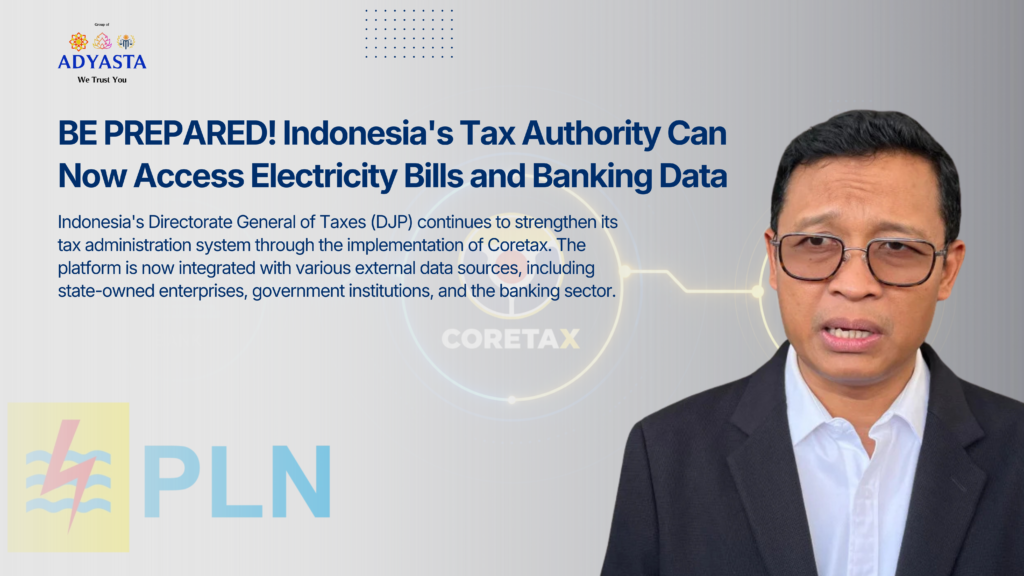



BE PREPARED! Indonesia’s Tax Authority Can Now Access Electricity Bills and Banking Data Through Coretax

DJP Appoints Strava and Kling AI as VAT Collectors for Digital Services in Indonesia
June 29, 2026
Government Classifies Ride-Hailing Drivers as MSMEs, Making Them Eligible for Tax Incentives and KUR Financing
July 6, 2026DJP Expands Data Integration Through Coretax
Indonesia’s Directorate General of Taxes (DJP) continues to strengthen its tax administration system through the implementation of Coretax. The platform is now integrated with various external data sources, including state-owned enterprises, government institutions, and the banking sector.
This integration is designed to help the DJP assess the reasonableness of taxpayers’ tax reports by comparing them with their economic activities and financial behavior.
Electricity Consumption Becomes One of the Assessment Indicators
One of the newly integrated data sources is electricity consumption and billing information from PT PLN (Persero).
According to the Director General of Taxes, Bimo Wijayanto, electricity usage can serve as an indicator when evaluating whether a taxpayer’s reported income and tax payments are consistent with their standard of living.
For example, if an individual owns a property with exceptionally high electricity consumption but reports relatively low annual taxes, the discrepancy may become a benchmark for further tax compliance analysis.
It is important to note that electricity bills do not automatically determine a taxpayer’s tax liability. Instead, they are used as one of several indicators in the DJP’s risk assessment and audit process.
Coretax Is Connected to More Than Just PLN
Beyond PLN, Coretax has been integrated with multiple institutions and databases, including:
- 55 domestic banks
- Telkom Indonesia
- AHU (Legal Entity Administration System) of the Ministry of Law
- Directorate General of Population and Civil Registration (Dukcapil)
- Financial Services Authority (OJK)
- Online Single Submission (OSS) System
By connecting these data sources, the DJP can obtain a more comprehensive view of taxpayers’ economic activities and compare them with the information reported in their tax returns.
Why Is This Data Integration Important?
The Indonesian government considers Coretax a key part of its tax administration modernization strategy, aimed at creating a more transparent, efficient, and equitable tax system.
With broader access to verified economic data, the DJP can perform more accurate compliance monitoring, identify inconsistencies, and better oversee both conventional and digital economic activities.
Ultimately, this initiative is expected to improve voluntary tax compliance while ensuring a fair taxation system for all taxpayers.
What Should Taxpayers Do?
For both individual and corporate taxpayers, the implementation of Coretax highlights the importance of maintaining accurate and consistent tax reporting.
Taxpayers are encouraged to:
- Ensure that reported income accurately reflects actual earnings.
- Report assets and financial transactions truthfully.
- Maintain consistency between economic activities, consumption patterns, and tax filings.
- Avoid discrepancies that may trigger further review or tax audits.
Maintaining accurate tax records not only reduces compliance risks but also supports a smoother tax administration process.
Conclusion
The implementation of Coretax marks a significant milestone in the modernization of Indonesia’s tax administration. Through integration with PLN, domestic banks, Telkom Indonesia, Dukcapil, OJK, OSS, and other government databases, the DJP is now equipped with stronger analytical capabilities to assess taxpayer compliance.
For taxpayers, this development serves as a reminder to ensure that all financial activities, assets, and tax reports accurately reflect their actual economic conditions. Proper tax compliance not only minimizes audit risks but also contributes to a fairer and more transparent taxation system in Indonesia.
Related posts
October 16, 2026
October 14, 2026
October 13, 2026