



DJP Appoints Strava and Kling AI as VAT Collectors for Digital Services in Indonesia

Why KBLI 2025 Is Creating Challenges for Business Owners
June 24, 2026
BE PREPARED! Indonesia’s Tax Authority Can Now Access Electricity Bills and Banking Data Through Coretax
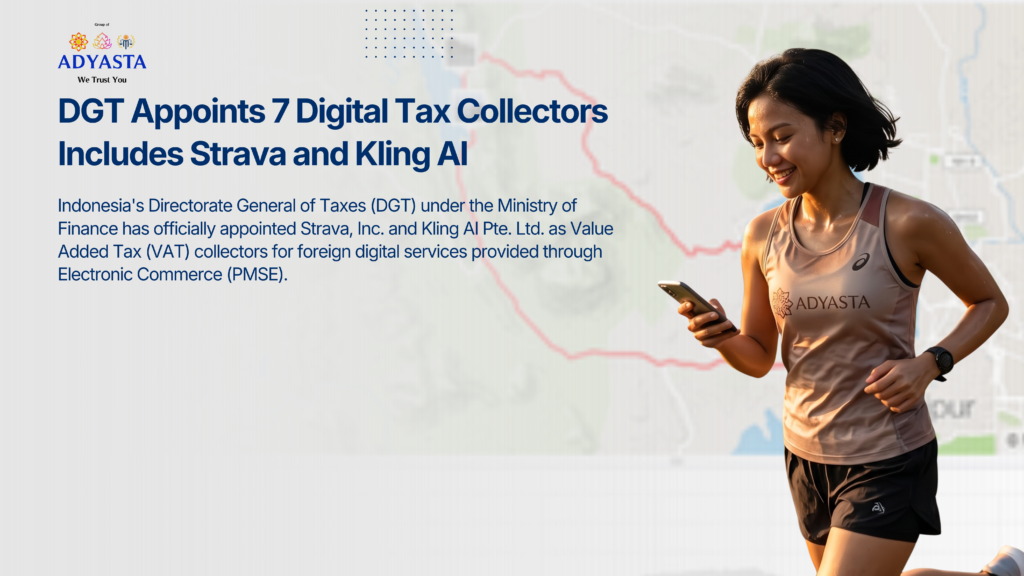
July 6, 2026Indonesia’s Directorate General of Taxes (DGT) under the Ministry of Finance has officially appointed Strava, Inc. and Kling AI Pte. Ltd. as Value Added Tax (VAT) collectors for foreign digital services provided through Electronic Commerce (PMSE).
The appointment reflects the Indonesian government’s ongoing commitment to ensuring fair taxation in the rapidly growing digital economy, particularly as more international digital platforms and AI services are used by consumers in Indonesia.
What is PMSE VAT?
PMSE VAT (Value Added Tax on Electronic Commerce) is a tax imposed on digital products and services supplied by foreign businesses to consumers in Indonesia.
Under this scheme, eligible foreign digital service providers are required to collect, remit, and report Indonesian VAT on behalf of the government, creating a more level playing field between domestic and overseas digital businesses.
About Strava and Kling AI
Strava
Strava is a GPS-based fitness tracking platform widely used by athletes and fitness enthusiasts to record activities such as:
- Running
- Cycling
- Swimming
- Hiking
- Various outdoor sports
Beyond activity tracking, Strava also functions as a social fitness platform where users can share achievements, join challenges, and connect with other athletes.
Kling AI
Kling AI is a generative artificial intelligence platform that enables users to create high-quality visual content automatically, including:
- Text-to-video generation
- Image-to-video generation
- AI-generated images
- Creative visual content from simple prompts
The platform has gained popularity among content creators, marketers, and businesses looking to streamline digital content production.
Six Additional Digital Companies Appointed
In addition to Strava and Kling AI, the DGT also appointed six other foreign digital companies as PMSE VAT collectors, including:
- Envato Pty Ltd
- The Nielsen Norman Group, Inc.
- Law School Admission Council, Inc.
- PLAUD LLC
- and other digital service providers operating across various industries.
These companies represent sectors ranging from digital content and education to artificial intelligence and fitness services.
Growing Diversity of Digital Services
According to Inge Diana Rismawanti, Director of Tax Dissemination, Services, and Public Relations at the Directorate General of Taxes, the inclusion of AI platforms and other digital service providers reflects the increasing diversity of digital services being utilized by Indonesian consumers.
This development demonstrates the government’s effort to keep tax regulations aligned with the rapid evolution of digital technology and online business models.
PMSE VAT Revenue Continues to Grow
Since the implementation of PMSE VAT, Indonesia has recorded consistent growth in tax revenue from foreign digital service providers.
| Year | VAT Revenue |
| 2020 | IDR 731.4 billion |
| 2021 | IDR 3.9 trillion |
| 2022 | IDR 5.51 trillion |
| 2023 | IDR 6.76 trillion |
| 2024 | IDR 8.44 trillion |
| 2025 | IDR 10.32 trillion |
| 2026 (through May) | IDR 4.88 trillion |
As of 31 May 2026, the Indonesian government had appointed 233 foreign digital companies as PMSE VAT collectors, generating a cumulative IDR 40.55 trillion in VAT revenue.
DGT’s Commitment to the Digital Economy
The Directorate General of Taxes emphasized that it will continue adapting its tax policies to keep pace with technological innovation and the evolving digital economy.
Its objective is to ensure that VAT collection remains:
- Fair
- Effective
- Legally certain for businesses
- Supportive of Indonesia’s digital economic growth
This approach reflects the government’s broader commitment to building a modern tax system capable of addressing the challenges of an increasingly digital marketplace.
Conclusion The appointment of Strava and Kling AI as PMSE VAT collectors marks another important milestone in Indonesia’s digital taxation policy. As AI platforms, digital services, and cross-border online businesses continue to expand, the government is broadening the scope of VAT collection to promote tax fairness, strengthen compliance, and enhance state revenue from the digital economy.
Related posts
September 18, 2026