

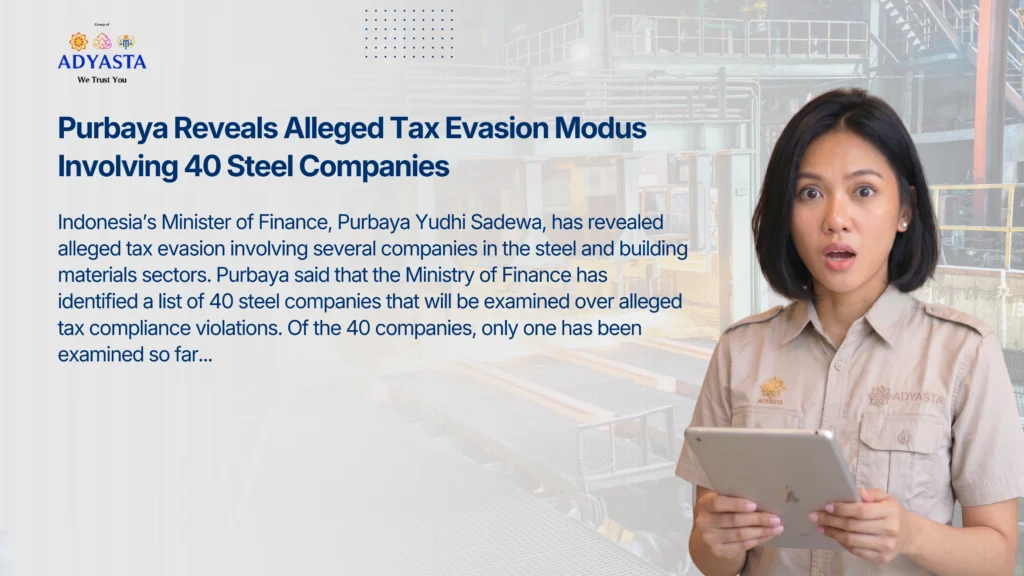




Purbaya Reveals Alleged Tax Evasion Modus Involving 40 Steel Companies

E-Commerce Tax Collection Postponed Until 2027, Purbaya: Waiting for Economic Conditions to Improve
August 27, 2026
IDR 632 Trillion! These Are the 5 Sectors Receiving the Largest Tax Expenditures in 2027
September 3, 2026Indonesia’s Minister of Finance, Purbaya Yudhi Sadewa, has revealed alleged tax evasion involving several companies in the steel and building materials sectors.
Purbaya said that the Ministry of Finance has identified a list of 40 steel companies that will be examined over alleged tax compliance violations. Of the 40 companies, only one has been examined so far.
Potential Tax Leakage Estimated at IDR 4–5 Trillion
Based on the Ministry of Finance’s findings, the potential tax leakage from these companies is estimated at IDR 4 trillion to IDR 5 trillion.
According to Purbaya, the potential losses are linked to companies in the steel and building materials industries that allegedly do not operate in accordance with applicable regulations.
Purbaya emphasized that the government plans to address these issues to improve state revenue and strengthen the competitiveness of domestic companies.
Alleged Modus Linked to Illegal Imports
The issue involves compliance with several types of taxes and duties, including Income Tax (PPh), Value Added Tax (VAT/PPN), and Import Duties.
Purbaya said that the problems have not been fully addressed this year due to delays in handling the cases by the relevant directorates.
He also stated that the main alleged tax evasion modus is closely related to illegal import practices.
The imported goods can subsequently be traded freely in the domestic market. Purbaya noted that the volume of goods involved is significant, making the issue complex and requiring more serious enforcement.
Government Prepares Further Action
The government plans to address these issues to improve state revenue and create a more competitive environment for domestic industries.
The examination of companies suspected of non-compliance is expected to help optimize tax revenue while addressing practices that could potentially cause losses to the state.
Conclusion:
The Ministry of Finance has identified 40 steel companies that will be examined over alleged tax evasion. The potential tax leakage is estimated at IDR 4–5 trillion, with illegal import practices being highlighted as one of the alleged methods used, where imported goods are subsequently sold freely in the domestic market.
Related posts
October 16, 2026
October 14, 2026
October 13, 2026