





Asset Forfeiture Bill Also Targets Tax Crimes

IDR 632 Trillion! These Are the 5 Sectors Receiving the Largest Tax Expenditures in 2027
September 3, 2026
No Tax Amnesty in 2027, Government Focuses on Improving the Tax System
September 11, 2026Indonesia’s Asset Forfeiture Bill does not only target corruption cases. Tax crimes are also included among the 13 types of criminal offenses covered by the proposed legislation.
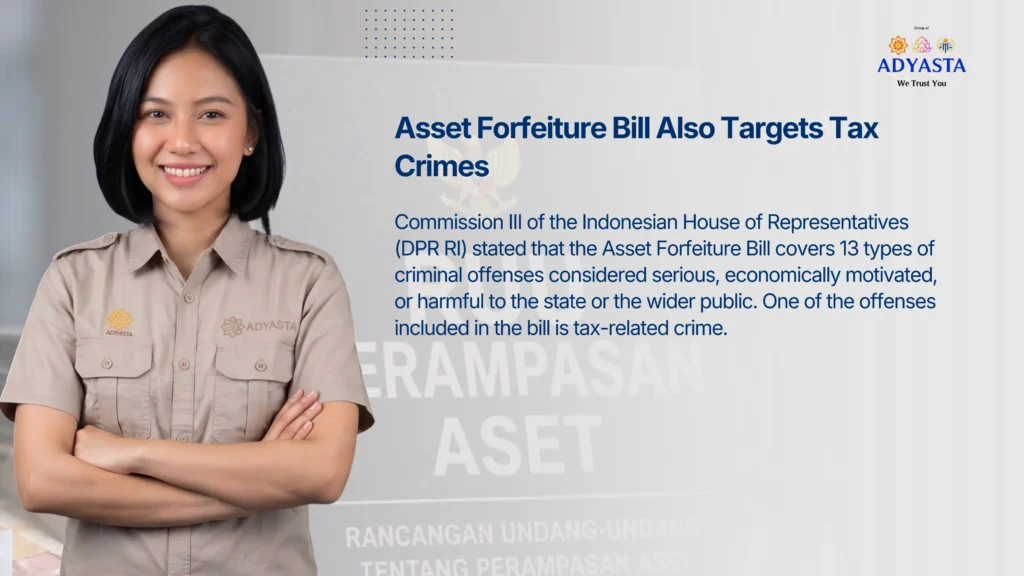
Commission III of the Indonesian House of Representatives (DPR RI) stated that the Asset Forfeiture Bill covers 13 types of criminal offenses considered serious, economically motivated, or harmful to the state or the wider public. One of the offenses included in the bill is tax-related crime.
13 Types of Criminal Offenses Targeted
According to the information presented by Commission III of the DPR, the Asset Forfeiture Bill covers the following 13 types of criminal offenses:
- Corruption
- Narcotics and psychotropic substances
- Terrorism
- Human smuggling
- Smuggling of weapons, ammunition, and hazardous materials
- Forestry-related crimes
- Environmental crimes
- Tax-related crimes
- Banking crimes
- Insurance-related crimes
- Mining-related crimes
- Maritime and fisheries-related crimes
- Human trafficking.
What Does This Mean for Taxation?
The inclusion of tax-related crimes within the scope of the Asset Forfeiture Bill means that assets connected to tax crimes could potentially become subject to asset forfeiture mechanisms in accordance with the applicable regulations.
Therefore, the proposed legislation is not limited to corruption cases. It also covers other crimes with an economic element, including offenses related to taxation.
The idea of expanding the scope of asset forfeiture had previously been raised by the Attorney General’s Office of the Republic of Indonesia. The institution argued that asset forfeiture should not only be applied to corruption cases but also to various economically motivated crimes, including tax evasion, fraud, embezzlement, environmental damage, and trade-related crimes.
Targeted for Completion by December 2026
Chairman of Commission III of the DPR, Habiburokhman, stated that the DPR is targeting the completion of discussions on the Asset Forfeiture Bill by December 2026.
The regulation is expected to strengthen Indonesia’s criminal justice system and make it more integrated.
Key Takeaway
The Asset Forfeiture Bill is not solely about corruption. Tax-related crimes are also included among the offenses targeted by the proposed legislation.
If the bill is eventually enacted with these provisions, assets connected to tax crimes could potentially be subject to asset forfeiture mechanisms in accordance with the applicable legal provisions.
For taxpayers and businesses, developments surrounding this bill are important to monitor, particularly with regard to tax compliance and proper asset management.
Related posts
October 16, 2026
October 14, 2026
October 13, 2026