

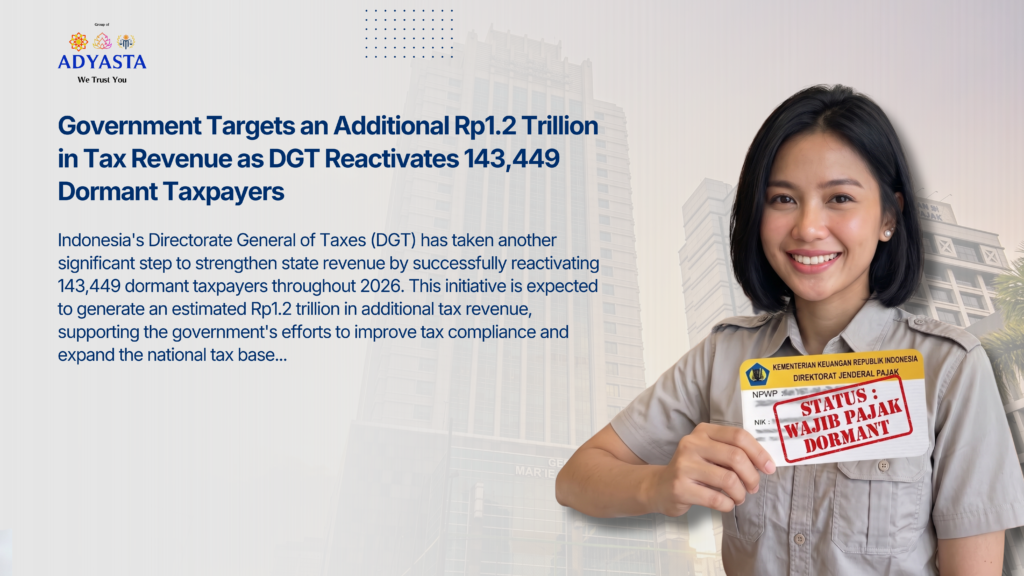


Government Targets an Additional Rp1.2 Trillion in Tax Revenue as DGT Reactivates 143,449 Dormant Taxpayers

Towards a More Modern and Advanced Tax System: Starting July 2026, All Tax Administration Will Be Handled Through Coretax
July 20, 2026
No Tax Rate Hike: Here’s How the Government Plans to Achieve Its Rp2.357 Trillion Tax Revenue Target
July 24, 2026Indonesia’s Directorate General of Taxes (DGT) has taken another significant step to strengthen state revenue by successfully reactivating 143,449 dormant taxpayers throughout 2026. This initiative is expected to generate an estimated Rp1.2 trillion in additional tax revenue, supporting the government’s efforts to improve tax compliance and expand the national tax base.
Data Optimization Instead of New Taxes
The reactivation of dormant taxpayers is not the result of higher tax rates or the introduction of new taxes. Instead, the DGT has optimized its tax administration system and data management to identify inactive taxpayers and encourage them to fulfill their tax obligations once again. This approach reflects the government’s commitment to improving tax administration through better use of technology and integrated taxpayer data.
Director General of Taxes Bimo Wijayanto explained that the achievement stems from the government’s tax extensification program, which utilizes previous tax reporting data and system enhancements to identify inactive taxpayers and restore their active tax status.
Estimated Rp1.2 Trillion in Additional Revenue
According to the DGT, the reactivation of 143,449 taxpayers is expected to contribute approximately Rp1.2 trillion in additional state revenue. This strategy enables the government to increase tax collections without imposing additional tax burdens on businesses or the public through higher tax rates.
Expanding Indonesia’s Tax Base
In addition to reactivating dormant taxpayers, the DGT continues to broaden Indonesia’s tax base by focusing on several underrepresented sectors, including:
- Businesses operating in the informal economy.
- Business operators that have not yet been registered in the tax system (shadow economy).
- Sellers conducting transactions through digital marketplaces and electronic commerce (PMSE) platforms.
Through these initiatives, the government aims to create a fairer and more comprehensive tax system where all eligible taxpayers contribute according to applicable tax regulations.
Protection for Micro Businesses Remains in Place
While expanding the tax base, the government has reaffirmed its commitment to protecting micro businesses. Individual taxpayers with annual business turnover of up to Rp500 million remain exempt from Income Tax (PPh). Meanwhile, businesses with annual turnover exceeding Rp500 million but not exceeding Rp4.8 billion continue to benefit from the 0.5% Final Income Tax scheme under the prevailing regulations.
Conclusion
The successful reactivation of more than 143,000 dormant taxpayers demonstrates that increasing tax revenue does not necessarily require raising tax rates. By leveraging data optimization, strengthening tax administration systems, and expanding the tax base, the Indonesian government seeks to improve voluntary tax compliance while ensuring sustainable state revenue growth.
For businesses and taxpayers, this development serves as an important reminder to maintain an active tax status and comply with all tax obligations in accordance with Indonesian tax regulations.
Related posts
October 16, 2026
October 14, 2026
October 13, 2026