

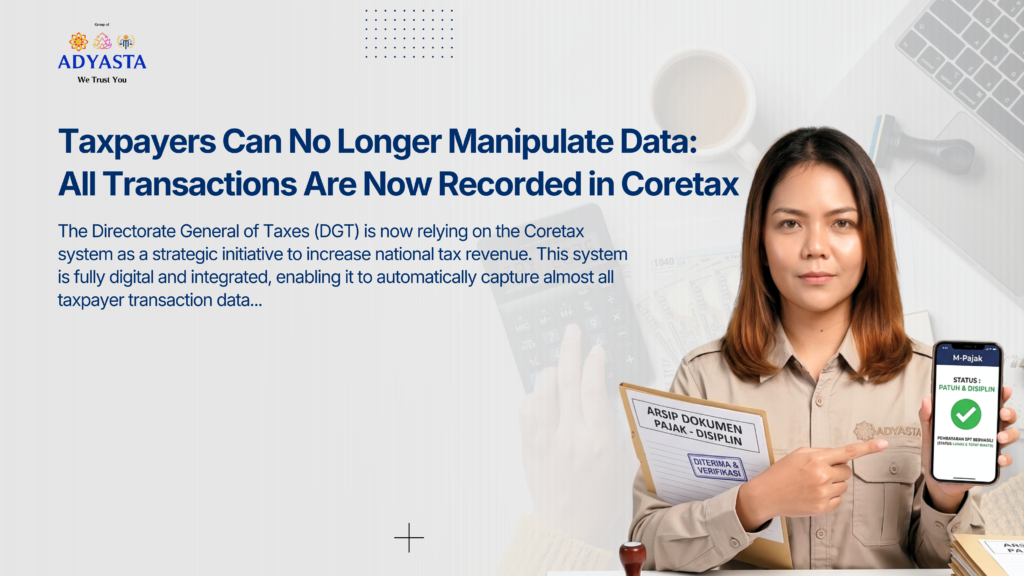



Taxpayers Can No Longer Manipulate Data: All Transactions Are Now Recorded in Coretax

Indonesia in “Survival Mode”: Finance Minister Purbaya Warns of Dismissal for Underperforming Officials
April 30, 2026
Accelerated Tax Refund: New Ease for Taxpayers under PMK 28/2026
May 6, 2026Indonesia’s Tax System Goes Digital
The Directorate General of Taxes (DGT) is now relying on the Coretax system as a strategic initiative to increase national tax revenue. This system is fully digital and integrated, enabling it to automatically capture almost all taxpayer transaction data.
With Coretax, Indonesia’s tax administration is becoming more modern, efficient, and transparent.
Prepopulated Tax Data for Greater Accuracy
One of Coretax’s key features is prepopulated data, which eliminates the need for manual tax data entry.
All transaction data is automatically recorded in the system, including information from related third parties involved in the transaction.
This significantly reduces input errors and ensures more accurate tax reporting.
Integrated Data from Multiple Sources
Coretax integrates data from various parties, not just the taxpayers themselves. These include:
- Employers
- Suppliers
- Customers
- Financial institutions
Because the data is interconnected, tax reports (SPT) are now much harder to manipulate or misreport.
Encouraging Higher Tax Compliance
With a more transparent and automated system, the DGT expects taxpayers to become:
- More honest
- More compliant
- More disciplined in filing their taxes
Improved compliance is expected to directly contribute to increased state revenue.
Stronger Tax Oversight
In addition to implementing Coretax, the DGT will also tighten supervision to ensure there are no tax leakages.
This reflects the government’s commitment to building a fair and accountable tax system.
Government Focus: Compliance Over Tax Increases
The government has emphasized that there are currently no plans to raise tax rates or introduce new taxes.
Instead, the main focus is on:
- Improving taxpayer compliance
- Closing loopholes in tax collection
Tax rate increases may only be considered when the economic condition is strong enough, for example when growth reaches around 6%.
Conclusion
Coretax marks a major milestone in Indonesia’s tax reform. With an integrated and automated data system, opportunities for manipulation are significantly reduced.
For taxpayers, this shift is not just about compliance—it’s about adapting to a more transparent and modern tax environment.
Related posts
October 16, 2026
October 14, 2026
October 13, 2026