

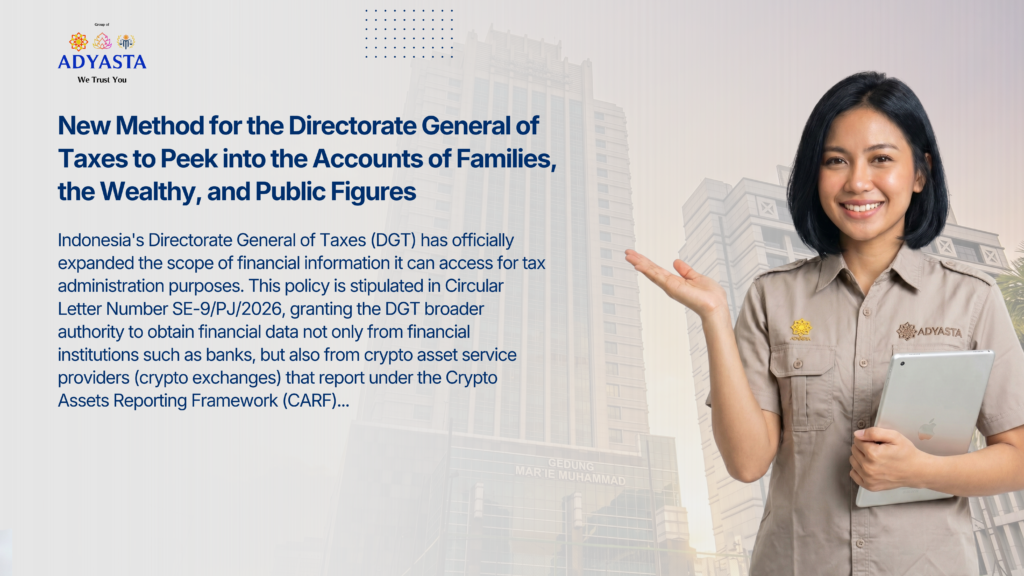


New Method for the Directorate General of Taxes to Peek into the Accounts of Families, the Wealthy, and Public Figures

Here’s the Process of Issuing an SP2DK for Unregistered Taxpayers
July 27, 2026
World Bank Proposes Lowering Indonesia’s VAT-Registered Business Threshold to IDR 500 Million: What’s Behind the Recommendation?
August 5, 2026Indonesia’s Directorate General of Taxes (DGT) has officially expanded the scope of financial information it can access for tax administration purposes. This policy is stipulated in Circular Letter Number SE-9/PJ/2026, granting the DGT broader authority to obtain financial data not only from financial institutions such as banks, but also from crypto asset service providers (crypto exchanges) that report under the Crypto Assets Reporting Framework (CARF).
What kind of information can the DGT obtain? Does this apply to all taxpayers? Here’s what you need to know.
DGT Now Has Broader Access to Financial Information
Previously, the DGT’s access to financial information was primarily limited to data provided by financial institutions. Under SE-9/PJ/2026, the scope has been expanded to include information from crypto asset service providers that participate as CARF reporting entities. This measure is intended to strengthen tax compliance monitoring as digital asset transactions continue to grow.
What Financial Information Can the DGT Request?
For tax administration purposes, the DGT may obtain various types of financial information, including:
- Account holder identity.
- Bank account or financial account number.
- Account type.
- Account opening and closing dates.
- Account balance or asset value.
- Transaction history.
- Transaction location.
- Other financial information relevant to tax administration.
Will All Taxpayers Be Subject to This?
No. Requests for financial information are not made for every taxpayer. According to the circular, the DGT may only request such information for taxpayers who meet certain criteria based on risk analysis and tax supervision requirements.
These may include taxpayers who:
- Have a high risk of tax non-compliance.
- Are currently under tax supervision.
- Are included in tax extensification programs.
- Are classified as High Wealth Individuals (HWI).
- Are public figures or other parties prioritized for tax supervision based on the DGT’s analysis.
Does the DGT Only Access the Taxpayer’s Information?
Not necessarily. In certain situations, the DGT may also request information concerning parties related to the taxpayer when such information is considered relevant to a tax audit or examination.
These related parties may include:
- Family members within the same tax data unit.
- Company directors or management.
- Taxpayer representatives.
- Shareholders.
- Beneficial owners.
- Other parties with transactional or legal relationships with the taxpayer, where deemed relevant to the examination process.
What Is the Information Used For?
The financial information obtained by the DGT may be used to:
- Monitor taxpayer compliance.
- Support tax audits and examinations.
- Assist in tax collection where outstanding tax liabilities exist.
During the tax collection process, the information may also serve as the basis for enforcement measures permitted under applicable laws, including asset blocking or seizure, provided all legal requirements have been fulfilled.
Conclusion
With the implementation of SE-9/PJ/2026, the DGT now has broader access to financial information. In addition to bank account data, it may also obtain information from crypto asset service providers that report under the Crypto Assets Reporting Framework (CARF). However, this authority does not apply to the general public as a whole. Instead, it is directed toward taxpayers identified through risk analysis and tax supervision criteria established under the applicable regulations.
Related posts
October 16, 2026
October 14, 2026
October 13, 2026