

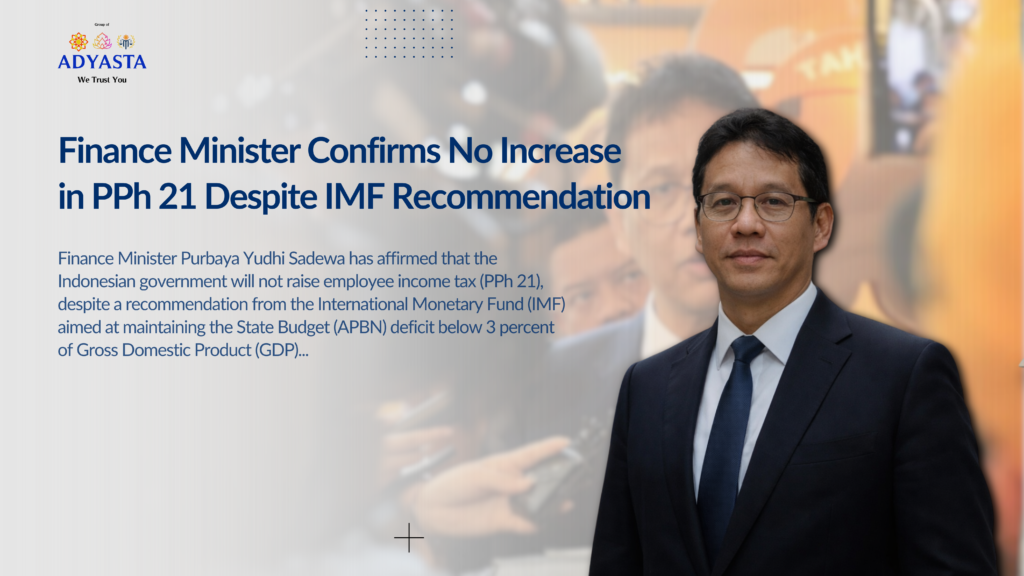



Finance Minister Confirms No Increase in PPh 21 Despite IMF Recommendation

Badan Amil Zakat Nasional Urges Companies to Fulfill Zakat Obligations During Ramadan
February 27, 2026
Divorced Couple: How to Separate a Joint Taxpayer Identification Number (NPWP)
February 27, 2026Finance Minister Purbaya Yudhi Sadewa has affirmed that the Indonesian government will not raise employee income tax (PPh 21), despite a recommendation from the International Monetary Fund (IMF) aimed at maintaining the State Budget (APBN) deficit below 3 percent of Gross Domestic Product (GDP).
According to the Minister, Indonesia’s budget deficit remains within a safe threshold, and therefore there is no immediate need to increase employee income tax rates. The government prefers to preserve economic stability and protect household purchasing power, particularly before the national economy reaches a stronger and more sustainable footing.
“Our deficit has not reached 3 percent. The IMF’s proposal is theoretically sound, but before our economy is strong, we will not adjust tax rates,” Purbaya stated at the Parliamentary Complex.
Government Focus: Expanding the Tax Base and Closing Revenue Gaps
Instead of raising PPh 21 rates, the government is prioritizing tax extensification measures, including expanding the taxpayer base and addressing potential revenue leakages. This approach is considered more equitable and sustainable than increasing the tax burden on employees.
The government also emphasizes the importance of accelerating economic growth so that tax revenues can rise organically in line with higher business activity and household consumption.
“Our priority is ensuring faster economic growth. If the economy grows, tax revenues will increase naturally, and the 3 percent deficit threshold can be avoided automatically,” he added.
IMF Recommendation from a Long-Term Perspective
In its long-term fiscal assessment, the IMF has suggested that Indonesia consider a gradual increase in employee income tax as a potential source of financing to strengthen public investment and support the national development agenda toward Indonesia Emas 2045. Nevertheless, the government reiterates that national fiscal policy will continue to be tailored to domestic economic conditions, taking into account stability, growth, and the protection of public purchasing power.
Related posts
October 16, 2026
October 14, 2026
October 13, 2026