

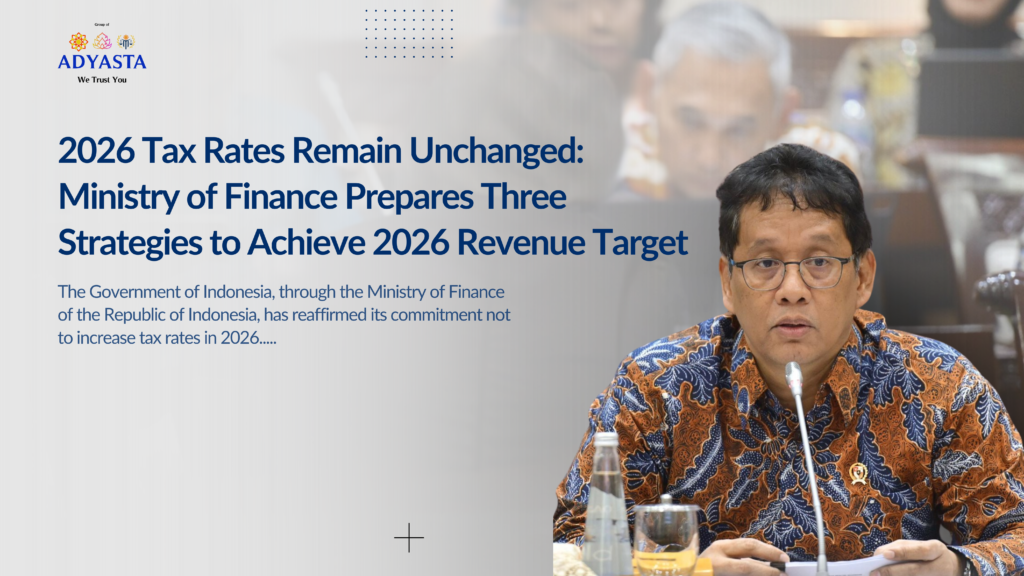


2026 Tax Rates Remain Unchanged: Ministry of Finance Prepares Three Strategies to Achieve 2026 Revenue Target

Divorced Couple: How to Separate a Joint Taxpayer Identification Number (NPWP)
February 27, 2026
Received a Tax Withholding Slip for Cashback in Coretax? Here’s the Simple Explanation
February 27, 2026The Government of Indonesia, through the Ministry of Finance of the Republic of Indonesia, has reaffirmed its commitment not to increase tax rates in 2026. Despite this decision, the government remains optimistic about achieving a tax ratio target of 11%–12%, while maintaining the state budget deficit below 3% of Gross Domestic Product (GDP).
Deputy Minister of Finance, Juda Agung, emphasized that optimizing state revenue will be the key to financing rising government expenditure without raising tax rates. Speaking at the Outlook Economic 2026 event in Jakarta, he stated:
“We will continue to ensure that the state budget deficit remains below 3%. The key question is how to further boost revenue so that expenditure needs can be covered by existing revenue.”
Three Key Strategies to Increase State Revenue
To achieve its fiscal targets, the Ministry of Finance has outlined three main strategic measures:
1. Digitalization and Improved Tax Compliance
The government is prioritizing efforts to enhance taxpayer compliance through the optimization of the Coretax system and the continued digitalization of tax administration.
This initiative aims to improve transparency, data accuracy, and administrative efficiency, ultimately maximizing revenue potential.
2. Stronger Law Enforcement
Stricter law enforcement measures will be implemented to close revenue leakages.
The government will rely on data-driven monitoring systems to detect reporting discrepancies earlier, more accurately, and in a measurable manner. This approach is expected to strengthen compliance and create a stronger deterrent effect against violations.
3. Tighter Supervision of Under-Invoicing Practices
The government is also addressing the issue of under-invoicing, a practice where export and import transactions are reported at values lower than their actual amounts.
Such practices can erode the country’s revenue base. Moving forward, supervision and enforcement actions will be intensified to address these activities more effectively.
Optimizing Revenue from Natural Resources
In addition to tax strategies, the government will strengthen governance of state revenue from the natural resources sector through the utilization of the Mineral and Coal Information System (SIMBARA).
This system is expected to enhance transparency, accountability, and revenue optimization in the mining and energy sectors.
At the same time, fiscal incentives will continue to be implemented selectively and prudently to maintain purchasing power and support sustainable investment.
Maintaining Fiscal Stability in 2026
Through improved compliance, stronger enforcement, tighter trade supervision, and better management of natural resource revenues, the government is confident that revenue targets can be achieved without raising tax rates. This approach reflects Indonesia’s commitment to safeguarding fiscal stability in 2026 while ensuring the state budget deficit remains within the mandated threshold.
Related posts
October 16, 2026
October 14, 2026
October 13, 2026