

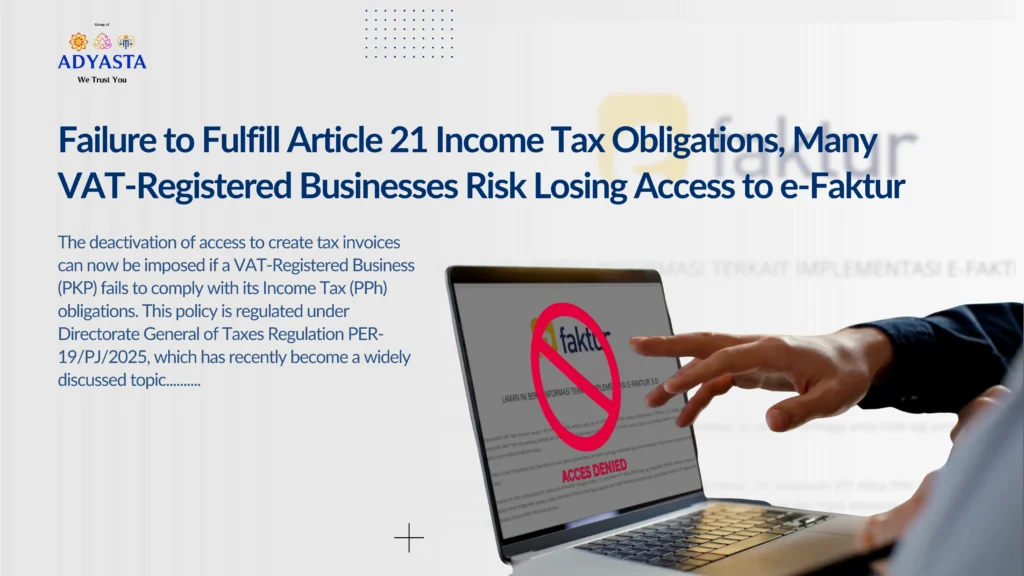


Failure to Fulfill Article 21 Income Tax Obligations, Many VAT-Registered Businesses Risk Losing Access to e-Faktur

Government Officially Makes 0.5% Final Income Tax for MSMEs Permanent
November 25, 2025
Christmas Carnival Bhumi Bali School Brings Joy, Giving, and Togetherness
January 2, 2026Legal Basis
The deactivation of access to create tax invoices can now be imposed if a VAT-Registered Business (PKP) fails to comply with its Income Tax (PPh) obligations.
This policy is regulated under Directorate General of Taxes Regulation PER-19/PJ/2025, which has recently become a widely discussed topic.
Three Criteria for e-Faktur Access Deactivation Related to Income Tax
Out of the six criteria stipulated in PER-19/PJ/2025, three are directly related to Income Tax obligations:
01 Failure to Withhold/Collect Income Tax
A PKP does not withhold or collect taxes that should have been carried out for three consecutive months.
02 Failure to Submit the Annual Income Tax Return (SPT)
A PKP does not file its Annual Income Tax Return, either the Corporate Income Tax Return or the Personal Income Tax Return of its management (as required).
03 Failure to Report Withholding/Collection Certificates
A PKP does not submit the report on the Income Tax withholding or collection certificates that have been issued.
If a PKP fails to comply with any one of the above obligations, the Tax Office (KPP) has the authority to deactivate its access to create tax invoices (e-Faktur).
Why Are Income Tax Criteria Included in Access Deactivation?
The Directorate General of Taxes states that Income Tax compliance is now easier to monitor because the administrative system has been integrated into DJP Coretax.
With Coretax:
• VAT, Income Tax, and tax return data are interconnected.
• The tax authority can view taxpayer compliance levels in real time and more accurately.
• Supervision becomes more effective, which is expected to increase tax revenue.
In Summary
e-Faktur access is now influenced not only by VAT compliance but also by Income Tax compliance.
PKPs must ensure that the withholding, remittance, and reporting of Income Tax are carried out properly to keep their e-Faktur access active.
Related posts
October 16, 2026
October 14, 2026
October 13, 2026