




Government Budget Efficiency on Tax Revenue

Business Actors Must Be Alert, This is the Consequence if Does Not Report LKPM
June 16, 2025
Celebrating Adyasta’s Birthday is More than Just a Celebration
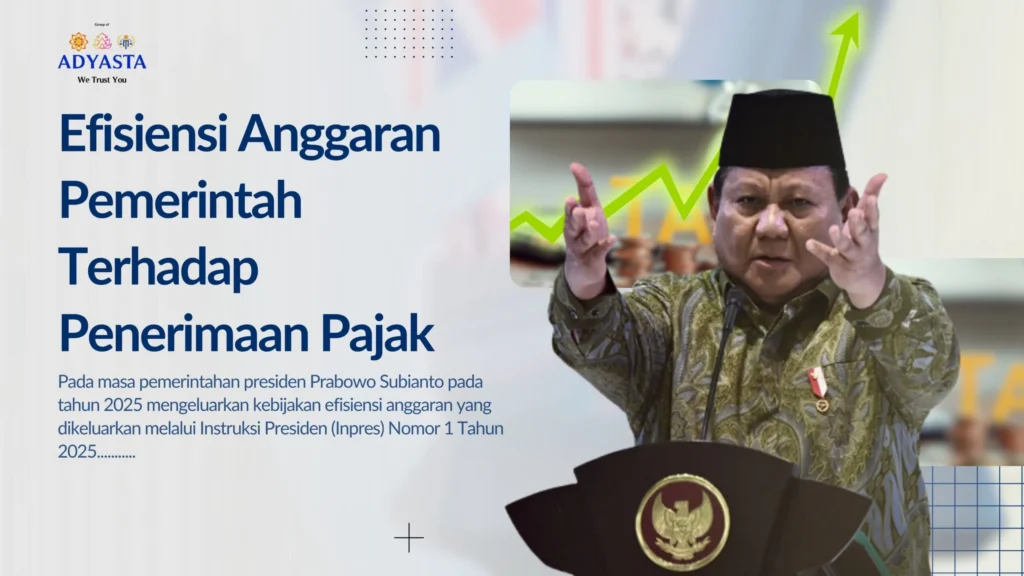
June 16, 2025During the Prabowo Subianto presidential administration in 2025, a budget efficiency policy was issued through Presidential Instruction (Inpres) Number 1 of 2025.
The government in 2025 carried out the efficiency of the State Budget and Revenue (APBN) of Rp306,695,177,420,000.00 (three hundred six trillion six hundred ninety-five billion one hundred seventy-seven million four hundred twenty thousand rupiah) consisting of:
First, Ministry/Institution expenditure budget of Rp256,100,000,000,000.00 (two hundred fifty-six trillion one hundred billion rupiah).
Second, transfers to regions amounting to Rp50,595,177,420,000.00 (fifty trillion five hundred ninety-five billion one hundred seventy-seven million four hundred twenty thousand rupiah).
Then what is the impact of government budget efficiency on taxes? Check out the following explanation:
Various impacts arising from budget efficiency may cause the public to have less trust in the government. The public will assume that the government’s budget efficiency is detrimental to them.
Thus, the question will arise in the community “why pay taxes, if it does not provide benefits for him”. It is this question that encourages people not to pay their taxes due to a lack of trust in the government.
President Prabowo Subianto’s budget efficiency policy is considered to be at risk of reducing tax revenue, especially Value Added Tax (VAT) and Corporate Income Tax (PPh) in 2025.
The state budget functions as an economic stimulus through state spending, so efficiency has the potential to reduce economic activity and suppress tax revenues.
Executive Director of MUC Tax Research Institute Wahyu Nuryanto believes that the government needs to recalculate the projection of tax revenue after the efficiency policy is implemented.
Wahyu detailed two main impacts of budget efficiency on tax revenue:
- People’s Purchasing Power Weakens
The termination of honorary workers and the reduction of employee spending can reduce household income, which in turn reduces public consumption.
As a result, VAT revenue from the consumption of goods and services may decrease. - Decrease in Industrial Sector Activities
Budget cuts for official travel, meetings, and seminars have an impact on the hotel, restaurant, and related services sectors. As a result, corporate income tax revenues from these sectors are at risk of declining. “I think the government really needs to recalculate tax revenue projections after this cut,” Wahyu added.
So what is the government’s objective in implementing Budget Efficiency?
The main objective of this budget efficiency policy is to ensure that each allocation of funds has a significant impact on priority development sectors. In this context, the government seeks to reduce waste and improve accountability in budget management. By doing so, it is hoped that greater transparency will be achieved, allowing the public to see first-hand how the state budget is being used for the public good.
Related posts
October 16, 2026
October 14, 2026
October 13, 2026