


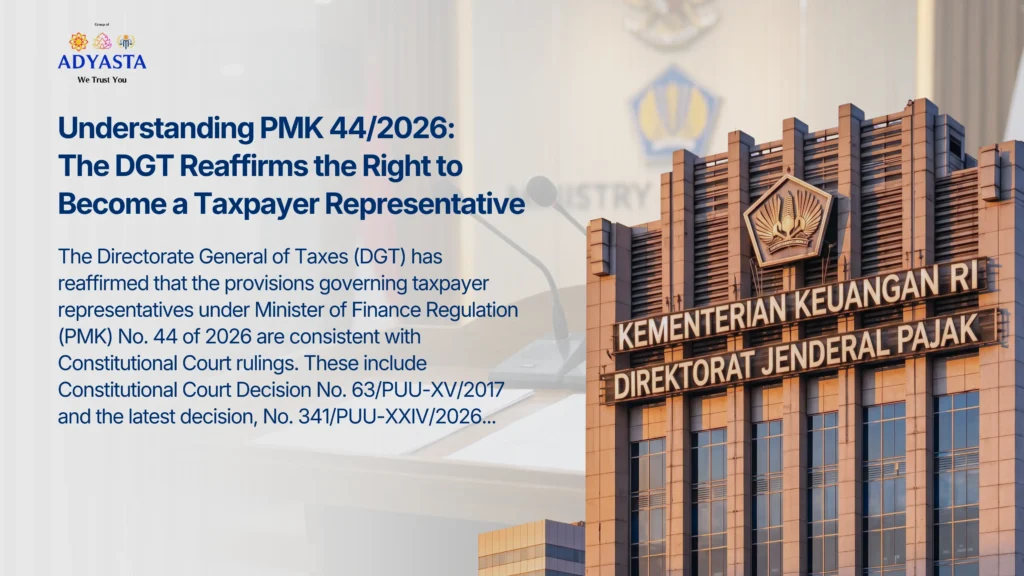
The Directorate General of Taxes (DGT) has reaffirmed that the provisions governing taxpayer representatives under Minister of Finance Regulation (PMK) No. 44 of 2026 are consistent with Constitutional Court rulings. These include Constitutional Court Decision No. 63/PUU-XV/2017 and the latest decision, No. 341/PUU-XXIV/2026.
PMK 44/2026 has attracted attention because it concerns the public’s right to act as a taxpayer representative in exercising tax rights and fulfilling tax obligations. However, the regulation is not intended to restrict who may become a taxpayer representative. Instead, it establishes administrative procedures to ensure compliance with the applicable legal framework.
PMK 44/2026 Does Not Restrict the Right to Become a Taxpayer Representative
The DGT emphasizes that anyone may still become a taxpayer representative, provided they meet the applicable competency requirements.
Meidijati, Head of the Subdirectorate of General Tax Provisions and Procedures (KUP) Regulations and Tax Collection by Warrant at the DGT, explained that PMK 44/2026 was formulated in accordance with the latest Constitutional Court decision. According to her, the Minister of Finance is authorized to regulate technical administrative matters, and the regulation focuses on these administrative procedures.
Therefore, the regulation is not intended to introduce new restrictions on the public’s right to become a taxpayer representative.
How Are Competency Requirements for Taxpayer Representatives Regulated?
To understand PMK 44/2026, it is important to distinguish between competency requirements and technical administrative procedures. These two aspects have different legal foundations.
1. Article 32 paragraph (3a) of the General Provisions and Tax Procedures Law (UU KUP)
The General Provisions and Tax Procedures Law establishes the competency requirements in taxation that a person must meet to act as a taxpayer representative.
2. Minister of Finance Regulation No. 44 of 2026
PMK 44/2026 governs the technical administrative procedures relating to the competency requirements established under the General Provisions and Tax Procedures Law. According to the DGT’s explanation, the regulation is not intended to expand or remove an individual’s constitutional rights to become a taxpayer representative.
This division of authority clarifies that competency requirements are established by law, while the ministerial regulation governs their administrative implementation.
What Does This Mean for Taxpayers?
For taxpayers, this clarification provides greater certainty regarding the legal framework governing taxpayer representatives. According to the source material, Constitutional Court Decision No. 341/PUU-XXIV/2026 found no exceeding of authority or restriction of rights in the provisions under review. PMK 44/2026 was therefore declared valid and not contrary to the law.
This means that the opportunity to become a taxpayer representative remains open to anyone who meets the taxation competency requirements under the General Provisions and Tax Procedures Law and follows the technical administrative procedures stipulated in PMK 44/2026.
For taxpayers who require assistance with tax matters, understanding these provisions is important to ensure that the individuals representing them meet the applicable requirements.
Conclusion
Minister of Finance Regulation No. 44 of 2026 emphasizes the importance of administering taxpayer representation in accordance with the applicable legal framework. The regulation is not intended to restrict an individual’s right to become a taxpayer representative, but rather to govern technical administrative procedures based on the competency requirements established under the General Provisions and Tax Procedures Law.
By understanding the division of authority between legislation and implementing regulations, taxpayers can gain a clearer understanding of their rights, the applicable requirements, and the procedures involved in appointing a tax representative.