


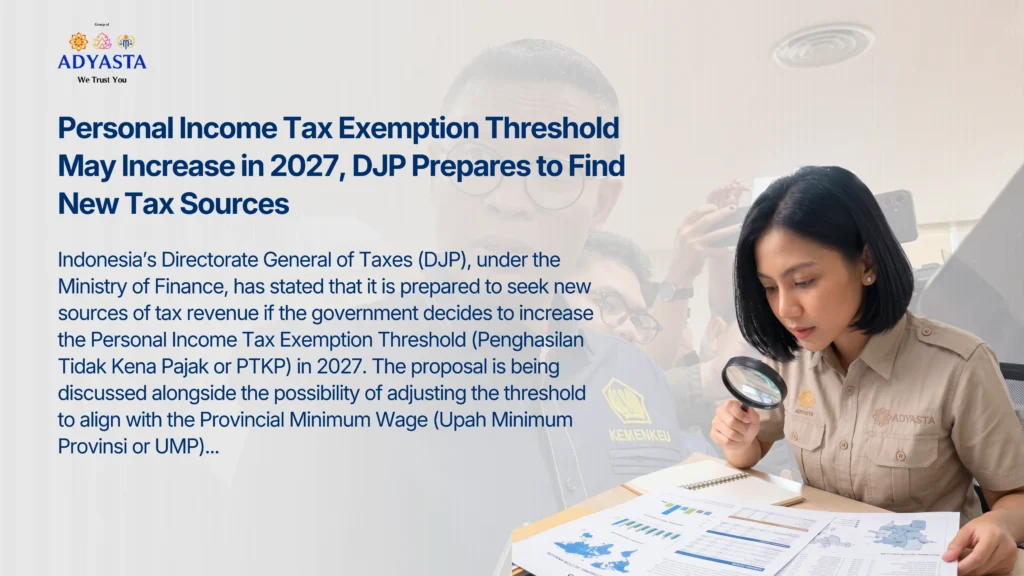
Indonesia’s Directorate General of Taxes (DJP), under the Ministry of Finance, has stated that it is prepared to seek new sources of tax revenue if the government decides to increase the Personal Income Tax Exemption Threshold (Penghasilan Tidak Kena Pajak or PTKP) in 2027. The proposal is being discussed alongside the possibility of adjusting the threshold to align with the Provincial Minimum Wage (Upah Minimum Provinsi or UMP).
An increase in the PTKP threshold could provide tax relief for individuals within certain income brackets. With a higher tax-exempt threshold, some taxpayers may pay less Personal Income Tax (PPh), while those whose income falls below the applicable threshold may no longer be required to pay personal income tax.
DJP Anticipates Potential Decline in Tax Revenue
Director General of Taxes Bimo Wijayanto acknowledged that an increase in the PTKP threshold could affect state tax revenue. Therefore, if the government approves the policy, DJP will need to prepare measures to anticipate the resulting changes in revenue.
One of the proposed measures is to identify new tax bases to help maintain state revenue. DJP is also considering expanding the tax base, improving taxpayer compliance, and optimizing the Coretax tax administration system.
However, DJP has not yet calculated the potential reduction in tax revenue in detail. Such calculations will depend on the government’s final decision regarding the amount of the proposed PTKP increase.
Policy Scenarios Remain Under Review
To prepare for a possible policy change, DJP has developed several scenarios. These scenarios have also been submitted to the Ministry of Finance’s Directorate of Economic and Fiscal Strategy for further assessment.
One of the key considerations is the contribution of individual taxpayers to state revenue, including taxpayers in income brackets subject to the highest personal income tax rates.
This indicates that the proposed PTKP increase involves more than providing tax relief to the public. It also requires consideration of the sustainability of government revenue.
What Is the Current PTKP Threshold?
According to the information provided in the source material, the current PTKP threshold for an individual taxpayer who is unmarried and has no dependents is IDR 54 million per year, equivalent to IDR 4.5 million per month.
For example, an individual earning IDR 5 million per month receives a total annual income of IDR 60 million. With a PTKP threshold of IDR 54 million, the difference between annual income and the exemption threshold is IDR 6 million.
This difference represents income above the PTKP threshold that may be subject to income tax calculations under the applicable tax regulations. However, the final tax payable cannot be determined simply by subtracting the PTKP from annual income, as the calculation must follow the applicable taxable-income rules and personal income tax rates.
Potential Tax Relief for Lower-Income Earners
If the government increases the PTKP threshold to align with the Provincial Minimum Wage, lower-income earners could potentially benefit from a reduced personal income tax burden.
At the same time, the adjustment would need to be accompanied by an adequate strategy to maintain state revenue. DJP has indicated that it is prepared to broaden the tax base, improve taxpayer compliance, and optimize Coretax as part of its response to the potential policy change.
Until the government officially determines the new threshold and its implementation date, individuals and businesses should continue monitoring developments in tax policy to understand how any changes may affect their respective tax obligations.
Conclusion
The proposed PTKP increase in 2027 could provide tax relief for eligible individuals. However, implementation remains subject to the government’s decision and further assessment, particularly regarding the size of the increase and its potential impact on state revenue.
For taxpayers, understanding the applicable PTKP provisions and personal income tax regulations remains essential to fulfilling tax obligations accurately.