


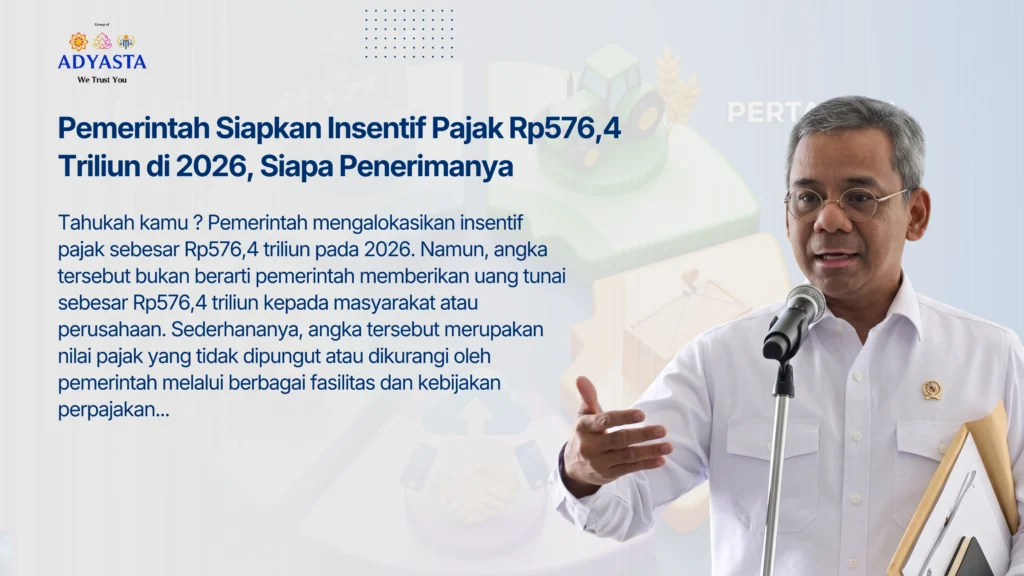
Did you know that the Indonesian government has allocated IDR 576.4 trillion in tax incentives for 2026?
But what does this figure actually mean?
It does not mean that the government is giving IDR 576.4 trillion in cash to businesses or individuals.
Simply put, it represents the amount of tax that the government does not collect or reduces through various tax facilities and policies.
As a result, more funds can remain in circulation within society and the business sector.
According to Indonesia’s Minister of Finance, Suahasil Nazara, these tax incentives are provided to support economic activity, particularly consumption, investment, and business activities.
Who Can Benefit from These Tax Incentives?
Tax incentives can take various forms, including tax exemptions, tax reductions, and special tax rates.
Some of the sectors receiving tax incentives include:
- Manufacturing
- Agriculture
- Trade
- Services
- MSMEs
This means that tax incentives are not limited to a single group of taxpayers. They are provided through various policies targeting specific sectors of the economy.
What Is the Purpose?
The government expects these tax incentives to help keep economic activity moving.
The main objectives include:
Maintaining consumer purchasing power
Encouraging investment
Supporting business activities
Improving business competitiveness
So, when you hear about IDR 576.4 trillion in tax incentives, it should not be understood as IDR 576.4 trillion in cash being distributed by the government.
Instead, it represents the value of taxes that are not collected or are reduced through various tax incentive policies.
In other words, the government is providing tax relief to help keep funds circulating in society and the business sector while supporting consumption, investment, and economic activity.