


KBLI 2025 Is Officially in Effect
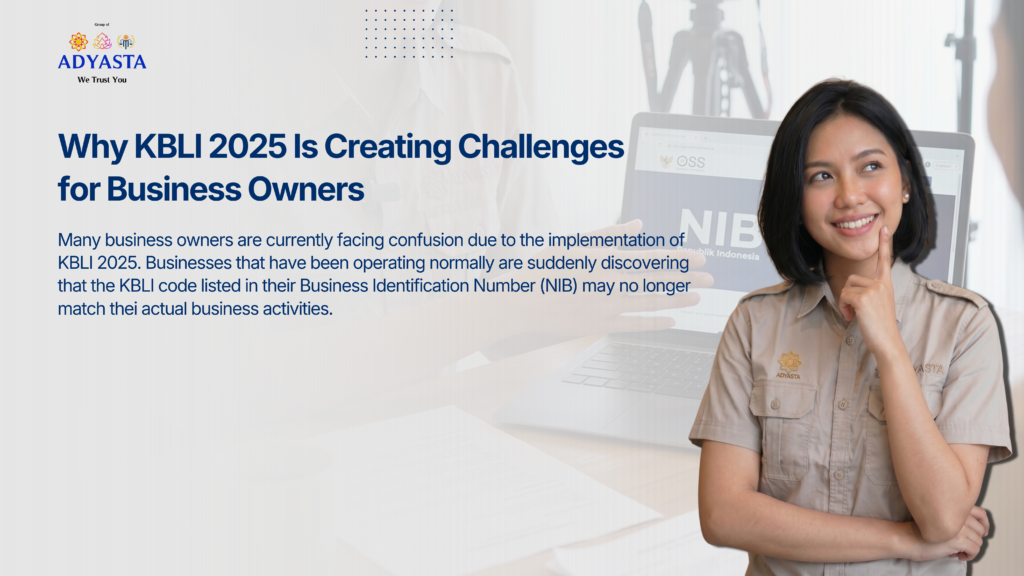
Many business owners are currently facing confusion due to the implementation of KBLI 2025. Businesses that have been operating normally are suddenly discovering that the KBLI code listed in their Business Identification Number (NIB) may no longer match their actual business activities.
To address evolving business models and improve regulatory accuracy, the Indonesian government has officially introduced KBLI 2025, replacing the previous KBLI 2020 classification system. The update aims to align the OSS (Online Single Submission) and AHU systems with current business practices.
Why Your KBLI Code Matters
Under the latest regulations, the KBLI code registered in your NIB must accurately reflect the business activities you conduct. Any mismatch between your registered KBLI and actual operations can create obstacles when applying for additional licenses or sector-specific permits.
For example:
- A clothing business must use a KBLI code related to clothing trade.
- A construction company must use a KBLI code that corresponds to construction services.
- Other businesses must also ensure their KBLI code accurately represents their operational activities.
Failure to select the correct KBLI code may result in licensing complications and administrative delays.
Sole Shareholder Companies Face Greater Impact
One of the most significant effects of KBLI 2025 is being felt by businesses operating as Sole Shareholder Limited Liability Companies (PT Perorangan).
The reason is simple: several business classifications have experienced changes in their risk levels. As a result, some KBLI codes that were previously permitted for PT Perorangan entities may no longer be eligible under the updated framework.
Examples of potentially affected business sectors include:
- Courier Services (KBLI 53200)
- Private Security Services (KBLI 80110)
- Wholesale Fuel Trading (KBLI 46710)
Although the implementation process is still being refined, business owners should proactively review their KBLI classifications to avoid future compliance issues.
Understanding the Risk-Based Approach
PT Perorangan was specifically designed for Micro and Small Enterprises operating within Low Risk or Low-Medium Risk categories.
If a business activity is reclassified under KBLI 2025 as Medium-High Risk or High Risk, the PT Perorangan structure may no longer be suitable or permitted for that business activity.
This is one of the main reasons why some business owners are encountering difficulties when updating data or applying for licenses through the OSS system.
What Should Business Owners Do?
If your business activity is now categorized as Medium-High Risk or High Risk, you may need to reconsider your business structure.
Possible solutions include:
- Upgrading to a Regular Limited Liability Company (PT Umum).
- Establishing a Commanditaire Vennootschap (CV), provided your business sector is legally allowed to operate under a CV structure.
Choosing the appropriate legal entity is essential to ensure smooth licensing processes and regulatory compliance.
Conclusion
KBLI 2025 is more than just a revision of business classification codes. It requires business owners to carefully review their legal compliance, including:
- Business activity classifications (KBLI)
- Risk levels
- Business entity structures
- Sector-specific licensing requirements
As the transition period continues, now is the ideal time to evaluate your company’s legal documents and ensure they remain compliant with the latest regulations. Need assistance reviewing your KBLI classification or business licensing compliance? Consult with experienced legal and corporate professionals to keep your business operating smoothly and in accordance with current regulations.