


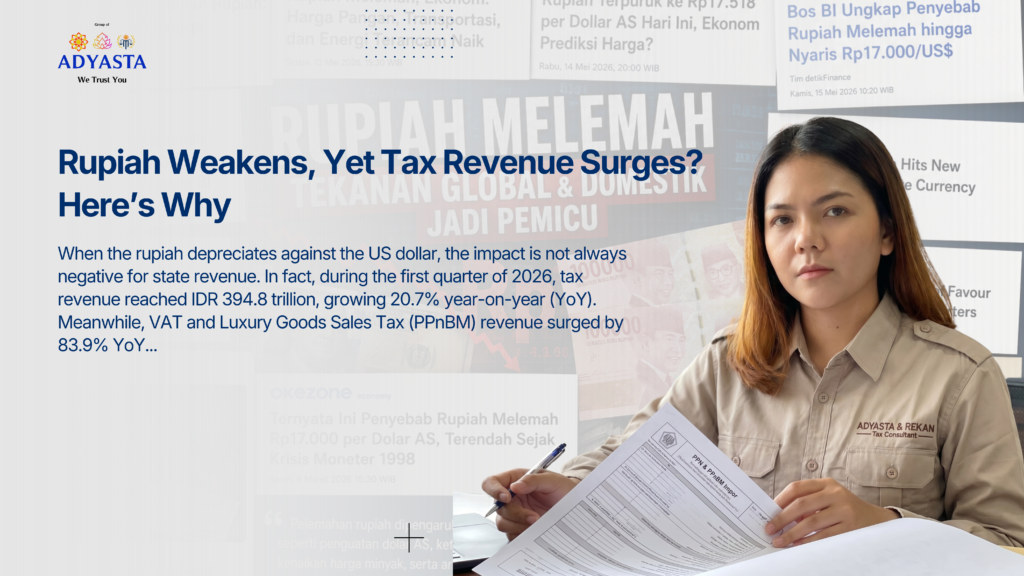
Amid headlines highlighting the weakening rupiah, an unusual phenomenon has emerged that many people rarely discuss: Indonesia’s tax revenue is actually increasing significantly.
When the rupiah depreciates against the US dollar, the impact is not always negative for state revenue. In fact, during the first quarter of 2026, tax revenue reached IDR 394.8 trillion, growing 20.7% year-on-year (YoY). Meanwhile, VAT and Luxury Goods Sales Tax (PPnBM) revenue surged by 83.9% YoY.
So, how does this happen?
1. A Weaker Rupiah Automatically Increases Import VAT
Imported goods are priced in US dollars. When these goods enter Indonesia, their value is converted into rupiah using the weekly tax exchange rate issued by the Ministry of Finance.
This means that when the US dollar strengthens:
- The Tax Base (DPP) increases
- 12% VAT automatically becomes higher
- Luxury Goods Sales Tax (PPnBM) also rises
Interestingly, this can happen even if:
- Import volumes remain unchanged
- Tax rates stay the same
In other words, a weaker rupiah directly increases the amount of taxes paid by importers.
2. Foreign Exchange Gains Become Taxable Income
Companies holding:
- Foreign currency assets
- USD receivables
- Cash in US dollars
will record foreign exchange (forex) gains when the rupiah weakens.
These gains are recognized in financial statements and become taxable income. As a result:
- Taxable profit increases
- Corporate Income Tax (22%) payments also rise
Even unrealized gains — profits not yet converted into cash — can still affect corporate tax obligations.
3. Exporters Benefit from a Weak Rupiah
A weaker rupiah can also benefit exporters.
For example:
A company generating USD 1 million in monthly revenue will automatically receive more rupiah once the dollar exchange rate increases, even without increasing sales volume.
The impact:
- Revenue in rupiah rises
- Taxable profit grows
- Corporate Income Tax contributions increase
This is one of the key reasons why tax revenue can continue to grow despite currency pressure.
But There’s Still an Economic Cost
Although tax revenue increases, a weaker rupiah still creates significant economic pressure.
Those affected include:
- Consumers, due to higher prices for imported goods
- Importers, because raw material costs rise
- Companies with dollar-denominated debt, as repayment burdens increase
- The government, since foreign debt payments become more expensive when the exchange rate exceeds the state budget assumption
This means higher tax revenue does not necessarily indicate a stronger overall economy.
Conclusion
The weakening rupiah may pressure many sectors of the economy. However, on the other hand, it can also boost tax revenue through:
- higher import VAT collections,
- foreign exchange gains,
- and increased exporter income.
This phenomenon shows that exchange rate movements do not only affect financial markets, but also have a direct impact on government revenue and corporate tax strategies.