


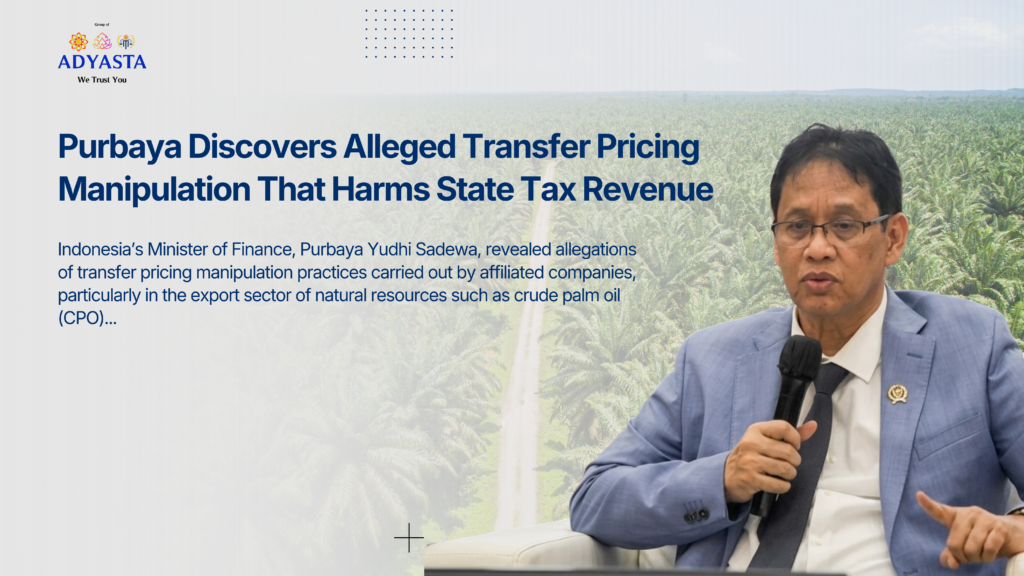
Indonesia’s Minister of Finance, Purbaya Yudhi Sadewa, revealed allegations of transfer pricing manipulation practices carried out by affiliated companies, particularly in the export sector of natural resources such as crude palm oil (CPO).
In simple terms, transfer pricing occurs when a company sells goods to its overseas subsidiary at artificially lowered prices. As a result, the company’s profits in Indonesia appear smaller or even show losses, reducing the amount of tax paid domestically.
According to Purbaya, the findings came from the analysis conducted by the National Single Window Institution (LNSW), which identified a pattern in CPO exports involving affiliated entities in Singapore before the products were shipped to their final destination countries. In this scheme, goods are sold from Indonesia to Singapore at low prices, then resold to destination countries at significantly higher prices. Consequently, most profits are recorded abroad instead of in Indonesia.
Purbaya stated that the selling price in destination countries could even reach double the export price from Indonesia to Singapore. This situation potentially causes substantial losses in Indonesia’s tax revenue.
To detect such practices, the government has begun utilizing artificial intelligence (AI) technology. The system is used to match shipping data, export-import records, cargo volumes, and international transaction prices, making suspected manipulation easier to identify. As part of its mitigation efforts, the government plans to require exports of strategic natural resource commodities such as CPO, coal, and ferro alloys to be conducted through state-owned enterprises appointed as sole exporters. The policy is expected to reduce transfer pricing manipulation, suppress underinvoicing practices, and optimize state tax revenue collection.