


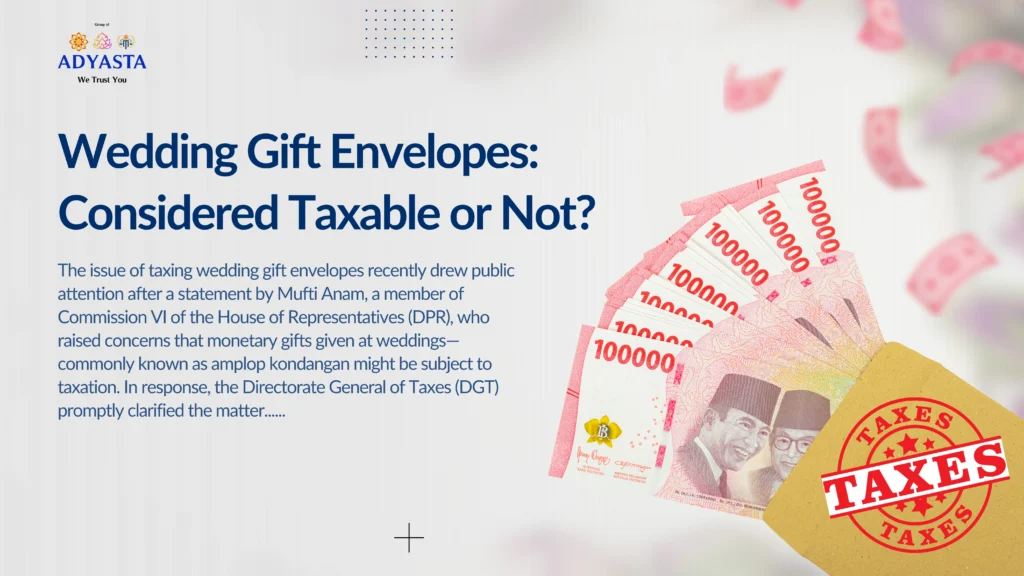
The issue of taxing wedding gift envelopes recently drew public attention after a statement by Mufti Anam, a member of Commission VI of the House of Representatives (DPR), who raised concerns that monetary gifts given at weddings—commonly known as amplop kondangan might be subject to taxation. In response, the Directorate General of Taxes (DGT) promptly clarified the matter.
1. Fundamental Principles of Taxation in Indonesia
Indonesia adopts a self-assessment taxation system, which means that each taxpayer is responsible for calculating, paying, and reporting their own income through the Annual Tax Return (SPT Tahunan).
2. Are Wedding Gift Envelopes Considered Taxable Income?
In general, Article 4 paragraph (1) letter b of the Income Tax Law (PPh Law) states that prizes or gifts are taxable income, especially if they are derived from:
- Lotteries,
- Employment, or
- Certain activities.
Such gifts are usually subject to income tax under Article 21 or 23.
However, personal gifts, such as wedding envelopes, are not automatically taxable. The DGT has emphasized that:
- If the gift is not routine,
- Unrelated to employment or business activities, and
- Purely a personal or social gift,
then it is not subject to tax and not a priority for tax monitoring by the DGT.
3. Additional Economic Capacity as Potential Taxable Income
In principle, any additional economic benefit received or obtained by a taxpayer has the potential to be taxable, unless explicitly excluded by law. For example, donations related to natural disasters are excluded from taxable income under Article 4 paragraph (3) of the Income Tax Law.
So what about wedding gifts?
In simple or modest weddings, gifts usually come from close family or friends, are personal in nature, and do not involve large sums of money. In contrast, gifts in luxurious weddings could involve sponsors or business relations, with significant or recurring value—potentially falling under the category of other domestic income. So, should wedding envelopes be considered taxable income or not?
Let’s talk it through together.