



DGT to Issue Supervisory Circular for Account Representatives Under PMK 111/2025

Progress of Annual Tax Return (SPT) Filing as of 9 February 2026
February 12, 2026
Get Ready! DGT to Send Email Blast to 14 Million Taxpayers
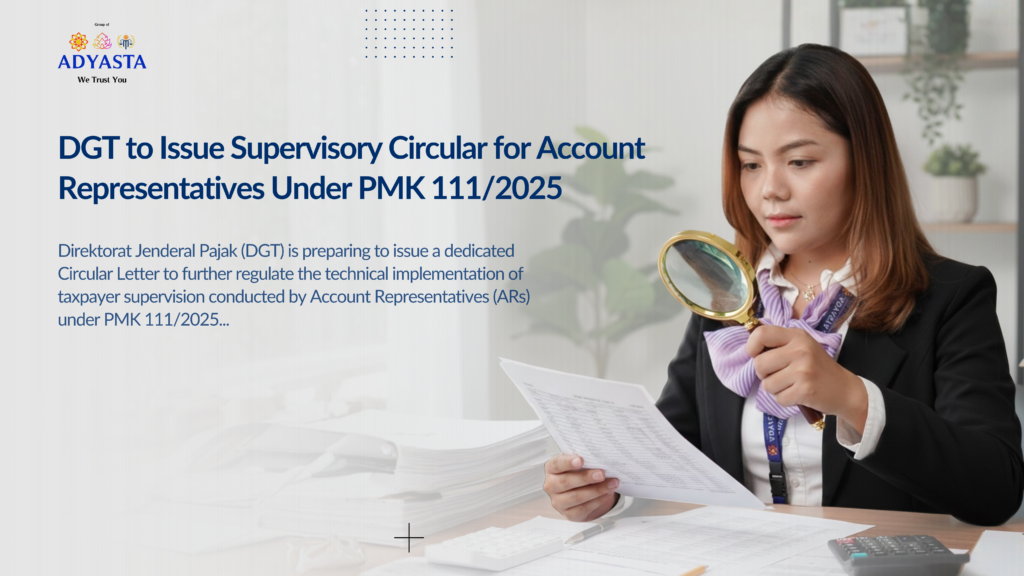
February 27, 2026Direktorat Jenderal Pajak (DGT) is preparing to issue a dedicated Circular Letter to further regulate the technical implementation of taxpayer supervision conducted by Account Representatives (ARs) under PMK 111/2025.
The forthcoming circular aims to provide greater procedural clarity and operational certainty, particularly in areas where the current Minister of Finance Regulation does not yet set out detailed supervisory mechanisms.
According to Eddy Triono, Senior Tax Counselor at the DGT, the circular will address several critical aspects necessary to ensure consistent, transparent, and accountable supervision practices.
Scope of Regulation Under the Upcoming Circular
The Circular Letter is expected to regulate, among others:
- The standardized format of the Supervision Assignment Letter
- Technical procedures for supervisory activities conducted by Account Representatives
- The legal basis underpinning supervisory actions
The objective is to establish uniform supervisory standards across Tax Service Offices (KPPs) and enhance legal transparency for taxpayers.
Legal Basis of Supervision: Mandatory Assignment Requirement
Article 21 of PMK 111/2025 explicitly stipulates that an Account Representative must obtain an official assignment from the Head of the Tax Office (KPP) in the form of a Supervision Assignment Letter prior to conducting any supervisory activity.
This requirement establishes that:
- All supervisory actions must be formally authorized
- Supervisory processes must be properly documented
- Taxpayers are entitled to verify the legal basis of supervisory actions
Absent such formal assignment, supervisory actions would lack procedural legitimacy.
Forms of Supervisory Activities Conducted by ARs
In practice, supervisory activities may include:
- Issuance of SP2DK (Request for Explanation of Data and/or Information)
- Technical discussions or clarifications with taxpayers
- Invitations to attend meetings at the tax office
- On-site visits
- Issuance of compliance advisories
- Requests for Transfer Pricing Documentation
- Collection of regional economic data
- Issuance of supervisory correspondence
- Other supporting supervisory activities
Important:
During field visits, interviews, or formal discussions, the Account Representative is required to present the Supervision Assignment Letter as proof of authorization.
Taxpayer Rights: Verification of Supervisory Authority
Taxpayers are legally entitled to:
- Request and verify the Supervision Assignment Letter prior to engaging in any supervisory process
- Ensure that supervisory actions are conducted in accordance with applicable regulations
This provision strengthens procedural transparency and protects taxpayers from informal or unauthorized supervisory measures.
Transitional Reference: SE-05/PJ/2022
Until the new Circular Letter is formally issued, supervisory technical guidance remains based on SE-05/PJ/2022.
The upcoming circular is expected to serve as an updated and more comprehensive operational reference for the implementation of PMK 111/2025.
Supervisory Framework Grounded in the General Tax Provisions Law (UU KUP)
The DGT has reaffirmed that taxpayer supervision is legally grounded in:
- Article 10 paragraph (2) of the General Tax Provisions and Procedures Law (UU KUP)
- Article 44E paragraph (2) of the UU KUP
According to Ahmad Rif’an, Tax Counselor at the DGT, because procedures concerning tax payment, remittance, reporting, Taxpayer Identification Number (NPWP) registration, and VAT registration are regulated at the Minister of Finance Regulation (PMK) level, supervisory mechanisms must likewise be regulated at the same normative level.
Accordingly, PMK 111/2025 formally strengthens the regulatory framework for taxpayer supervision as part of broader efforts to enhance:
- Legal certainty
- Administrative governance
- Compliance oversight
Conclusion: Why This Development Matters
The issuance of the supervisory Circular Letter represents a strategic regulatory step by the DGT to:
✔ Provide procedural certainty for Account Representatives
✔ Ensure transparency and accountability in supervisory processes
✔ Safeguard taxpayer rights through formalized assignment mechanisms For taxpayers and corporate entities, understanding these supervisory procedures is essential to responding appropriately, maintaining compliance, and mitigating procedural risks under the evolving regulatory framework.
Related posts
October 16, 2026
October 14, 2026
October 13, 2026